“Who are you?”
A man asked a little girl in front of me. In his view, he was helping her find her identity. She said,
“I’m a unique person. I’m a person who likes new ideas and different ways of doing things.” But it wasn’t what the man expected. So, he kept asking “who are you?” But I understood her, as I identify myself just like she did. Not with titles or labels, but how I approach life. In other words, titles that society has given me are not essential to me.
In general, women experience more transitions in their lives than men, not only chronologically but also by the space they belong to. Time and space give them various titles that represent the roles and tasks they perform. We are a wife, mother, homemaker, gardener, cook, tutor and a caregiver to the elderly, for example. Many women also have a title at work. And those titles are perceived to be a big part of their identity.
That has been rather bewildering to me. It’s not how I define myself. The more irksome part is that those external identities seem to change my value as a person depending on the main title that they see me with at that moment. But I’m the same me, even though the outlook of my life may change through time and space.
I’ve worked outside the home most of my life. And I’m happy that I can share some of the financial responsibilities with my husband. But is it essential to who I am?
I’ve always felt that the essence of who I am is in my brain. Several friends of mine have expressed their disagreements,
“You don’t know who you are, really. You don’t know what you’re doing.” It may be true in a sense that I don’t know what I’m doing in comparison to others and how I appear to others. But I know my intentions. I know my attitudes. I know what went on in my head when I made a decision. I know who I am.
I’m aware, though, that my body projects a certain image. When I was in a tennis match not long ago, one of my opponents told her partner.
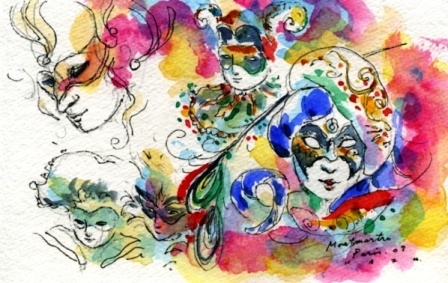
“She’s not what she seems. She’s tricky. Be careful.” I felt as if my body was smeared with slime. I protested in my head, “Tennis is to some degree a dirty game. You try to hit the ball where your opponents can’t reach it. Or you change your pace and try to surprise them. That’s the name of the game! However, I know what she meant. Michiko is short and looks weak and benign but she can play mean tennis when she wants to. I shouted to the other side of the court, “I’m not tricky, I’m desperate sometimes!” It is true that I try to be creative and a bit mean when I’m desperate on the court.
That brief conversation lingered in my head for a while. The fact that they thought I was deceitful bothered me a little. People create an image of you and tend to believe that is true. And they are surprised and feel betrayed when that image doesn’t match your behavior. You can’t win, unless you have the power to constantly project your self-image to the world and convince them. Most of us are too busy to do it, and we can also see how futile it can be. So, you accept the gap between other’s perception of you and your understanding of yourself.
But we, including me, all like giving labels to others and feeling as if we understand them. Oh, you’re a salesman? You must be a smooth talker. I need to be careful when you promise something. Oh, you’re a gardener. You must be kind and caring. I don’t really know you, but that’s what we expect from a person who is nurturing. Please don’t disappoint me.
But I’ve seen many different personalities under the same title. That’s because people bring their being into what they do. I know a sales person who is honest almost to a fault. Being a gardener can’t be a certificate of his/her gentle attitude towards living things.
This gap in perceptions is one of the two reasons why I want to denounce titles as the sole way to identify others. The other reason is that the titles can be situational. My parents didn’t get much education because their families were poor. But they’re wiser and more knowledgeable than me. It was the situation, the war and its aftermath, that dictated the course of their lives and gave them titles that were not so fancy. Thanks to their hard work and thrifty life style, I was able to go to college, and my titles look better than my parents’. So, our titles are not always a good reflection of who we really are.
For me, who I am comes from my attitude. Can I treat others with kindness? Whatever the title of the moment may be, can I perform my work with a positive attitude?
The world usually doesn’t care about this. It’ll still judge me by my appearance and titles, and the image those things conjure in other’s heads. This is not comforting, however, it’s easier for me to accept this gap, as most of my titles are fairly decent. This is an irony of sort: I don’t want to be identified by my titles, but at the same time, my titles are making my life easier.
Sometimes I wonder, how wide this gap would be and how frustrating it might be, if I were an African-American. If I had a handicap. I know I wouldn’t be able to handle that gap very well.
I understood what you meant when that you wrote “titles are not always a good perception of who you are.” I have been in that situation as well. It was comforting to know I wasn’t the only one. I always enjoy the artwork you post. It is beautiful!
LikeLike