Japan is a very good place to live if you have friends or family there. There’s a lot of kindness and good will to go around.
I recently spent time with my father in Northern Japan. My daughter needed to practice piano, but my father didn’t have one. I casually mentioned this to one of my friends, and her sister, Reiko, welcomed my daughter to her house. I was deeply touched by this, as I hadn’t seen her for more than 40 years.
However, kindness and good will are not always enough to bring light to one’s life. My heart sank every morning, when I went out on the small deck of my father’s house to hang clothes to dry. My gaze would fix on one of the houses across the street. A very nice elderly lady, whom we called Aunt Sato, had lived there. But she had killed herself several months ago. She was one of the longest residents in the neighborhood. She had watched my parents’ dog when my mother came down with cancer. And the neighbors had also helped her.
A part of her fence collapsed when the Great East Japan earthquake hit in 2011. A carpenter built a new fence and then added a new wooden structure to connect her house and the fence. This was to prevent the fence from falling and hurting people in the street. The structure was complete, but Aunt Sato needed to paint it herself, as the carpenter needed to repair many other houses. My father wanted to help her, but he knew that she’d decline his offer. So, he started painting it without telling her. And then another neighbor joined him. Of course, she discovered what they were doing and invited them for a snack. It seemed that they enjoyed themselves and supported each other.
Her daughter lives nearby and Aunt Sato was going to move in with her the next day. She gave my father her new address. That evening, a light of her house stayed on. Nobody knew what had happened until the next morning.
My father maintains that she didn’t have to die, and that she should’ve considered herself lucky. But, you never know what goes on in others’ minds. Maybe she didn’t want to become a burden to her daughter. Or she didn’t want to leave her own house.
Until I moved to the U.S., I didn’t know Japan’s suicide rate was high. In 2014, 19.5 Japanese per 100,000 killed themselves. It was the second highest rate among major economies, second only to Russia’s 21.8. The suicide rate in America was 13.4. Many people have asked me over the years why Japanese take their own lives, and I’ve always given them my proforma response: Japanese group harmony works well when you’re included in a group, but you may feel isolated or even ostracized when you don’t go along with the group ethos or mores. This cultural aspect hits some Japanese particularly hard if they don’t have a strong sense of identity.
I know this is not true for every suicide in Japan. Certainly, from the outside, this doesn’t explain Aunt Sato’s decision. She had friends who cared about her and a daughter who wanted to live with her.
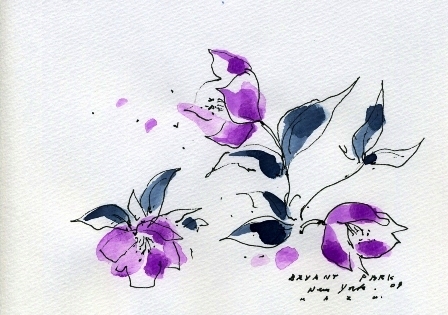
Aunt Sato was an avid gardener. Her hydrangea towering over her fence was in full bloom. I couldn’t take my eyes off it when my daughter and I walked to Reiko’s house. It was proudly showing off its beauty. On our way home, her hydrangea would suddenly appear as soon as we turned a corner to an alley that runs through the neighborhood. The flowers were gorgeous, but the blue and purple petals looked pale, as if they were melancholy. But each time, I wiped away that feeling, telling myself that I was merely being sentimental. Aunt Sato’s hydrangea was enjoying its life to the fullest, thanks to her care over the years.
Plants live by nature’s rhythm. They know when to grow new leaves and buds, and when to bloom. They also know when to wither and prepare for the next spring, or to return back to nature to become part of soil where new life begins again.
I wish we could all live until nature decides it’s time to go back to where we came from.