I believe in science. But I question the concept of evolution when I look at my cats. The law of natural selection doesn’t seem to apply to them. One of them is a hunter. She crawls very slowly and low on the floor whenever she sees a bird on the porch railing, only to be reminded that there’s a glass window that separates their worlds. It may sound as if she’s a true cat, but she falls on the floor when she makes sharp turns. The other cat is a climber. She climbs up the scratching post, but then climbs the sofa horizontally so that she moves herself across the floor. She also chews on every electric wire she finds. She has destroyed countless cell phone chargers and forced my family to go wireless. In addition, she has an extremely short memory and we have given up on teaching her anything.
These two cats have nothing in common when it comes to their personalities. When the one is hunting a bird, the other walks over to her to ask “What are you doing? Are you Okay?”
My point is that they wouldn’t know what to do if there were left alone, and certainly won’t be able to survive in the wilderness. If you fall on the floor, you probably won’t be able to chase a mouse on a bumpy field. I’m not sure if my climbing cat has a purpose. Even if she had a purpose, she wouldn’t remember it when she gets to where she was going. They are fine cats, but my question remains. How did their ancestors survive long enough to deposit their genes to these funny cats?
“They have great surviving skills.” My husband tells me, “Their ancestors succeeded in finding pushovers like you who took care of them.” I guess that holds some truth, but I’m not convinced about their evolution yet.
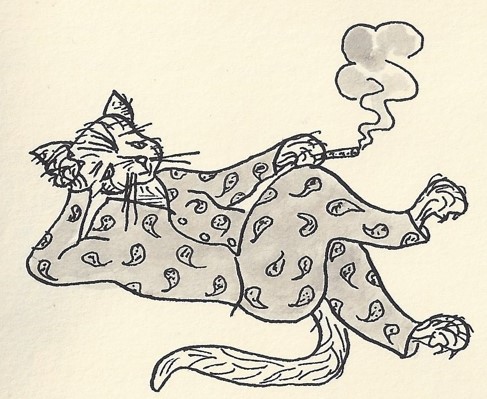
Whether the cat species has evolved or not, however, they are amazing. They have the power to control us (or at least me). They have many different personalities, and their fur patterns are all different from each other. Tigers have tigers’ pattern. Leopard and cheetahs and lions have their distinct patterns, too. But cats’ coats have endless variations. Maybe they’re one of the most advanced species on earth in terms of diversity.
I sometimes wonder if humans could learn from cats.
Some Japanese are interested in where their ancestors came from. Japan is located in the Far East, and many different kinds of people reached there in the ancient times, by land and sea. We may be close to Mongolians, Pacific Islanders, Chinese or Koreans. I’m interested in history, and believe that current science may be able to give us more accurate analysis. But some Japanese feel we shouldn’t take that route. Knowing our ancestors’ roots may make us feel vulnerable since we may lose part of our identity as Japanese.
According to legend, Emperor Jinmu is the descendant of one of the Japanese gods, and this lineage continues through to the current Emperor and crown prince. Emperor Jinmu’s tomb is located in Kashihara, Nara. If we really want to know our ancestors, the government can actually excavate it and examine artifacts and possibly even his DNA. However, it probably won’t happen in the foreseeable future. There are 124 emperors’ tombs in Japan, but the Imperial Household Agency won’t allow any of them to be excavated.
Some people want to keep it that way, especially Emperor Jinmu’s tomb who connects today’s Japanese to our mystical gods. Japanese may have an identity crisis if we discover that we are connected with other people in different parts of the world. This notion may sound strange in the U.S., a nation of immigrants. However, this concern is plausible in Japan where its national identity largely lies on racial homogeneity. I also understand this sentiment; we want to keep the legends and myths alive.
But I would argue that Japanese became Japanese after our ancestors began living in Japan. That is what my high school English teacher said, and that made me examine my cultural identity. Whatever our ancient origin may be, we can celebrate our traditions and way of life.
Why do Japanese care so much about their origin? My best guess is that is because it’s a mystery. And while we are curious, we are at the same time afraid of what we’ll discover and where it would lead us.
Japanese have the same attitude towards serious illness. While Americans want to know the diagnosis and prognosis of their ailment so that they can plan their lives better, many Japanese still choose not to know. Doctors talk to the patient’s immediate family members, but not necessarily to the patient. A Japanese proverb summarizes this: ignorance is bliss. Indeed, what you don’t know won’t hurt you. But I believe knowing will liberate us. The facts of our ancestry may rattle us a bit, but in the end, the sense of connection with other people beyond the Japanese archipelago will make us feel more like citizens of the world.
When my husband and I married, he had a cat. I’d never lived with one, and didn’t know what to do with her. But she had a clear idea how to use me. I was her door-opener and then her heating pad to provide warmth when she needed it. She also spoke Cat-glish. Really! She couldn’t meow, as her jaw had been damaged by a car accident, but I could understand her. “Where have you been?” when I came home from work, “Dinner!” around 7 o’clock, “Dessert!” and finally, “Bed!” She pretty much ran my life, but she was sweet, too. She would come right next to me and comfort me when I was feeling low.
She didn’t care if she could meow but was sensitive to other’s feelings. Come to think of it, cats are special beings. Every cat has a different coat. Sure, some of them look similar, but they don’t have a coalition based on their coats or behaviors. And even my funny cats who make me doubt evolution seem free of prejudice.
They don’t seem to care about how they look, where they came from. They just keep living. I wish humans would be like that. If we all looked different, with stripes and dots, the invisible lines that divide humans by our “us vs. them” mentality may lose its power, and the world would be a better place to live.
If humans can do that without changing our appearances, then, we’ll be true masters of life.