Twenty-five years ago, I flew over the Pacific Ocean and crossed an invisible border. When I landed on the U.S. soil, I became a person who couldn’t speak. That was a fundamental shift from being a person who couldn’t speak in English. That inability, which had been a fraction of my being since it didn’t matter much in Japan, now almost defined my personhood. I also noticed that other people’s perception of me was sometimes diametrically opposed to my own perception of myself. Despite my lack of language skills, I still thought of myself as a decent and capable person. In contrast, a piano teacher at the local community college, for example, thought I was a helpless little girl who was practically kidnapped by an ill-intentioned American. For her, I was a “poor thing,” and she called me that many times rather affectionately.
This gap in perception was quite interesting to me, and I started to wonder what was going on in Americans’ heads. So, when my English improved, I signed up for a psychology class at the New School in Manhattan. Although I don’t remember the title of the class, I do remember the title had nothing to do with what we learned.
Five minutes into the class, I had already realized that this class would be nothing like a regular class. The teacher was about eighty years old and wore a red dress and a red hat; she looked like a hot chili pepper. She introduced herself and said,
“Well, the New School is known for being hot for two reasons. For one, the air conditioner never works well, so it’s always hot. And the ideas we discuss here are very hot, very radical.” To me, she seemed to be a personification of that hotness, and I smiled with excitement.
All the students were female, and several of them had known her from previous classes. The teacher invited her students to share any issues they had. With that, I realized we were not going to learn psychology. This was going to be a therapy session. One of the newcomers, a pretty young newlywed, raised her hand.
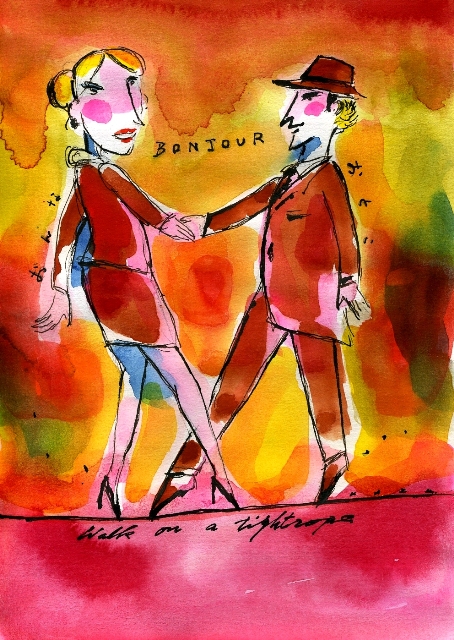
“My husband doesn’t give me a special birthday party.” What?
The teacher took a breath and said calmly, “Well, that’s not the end of the world.”
“Yes, I know.” The young woman quickly shot back, “but my birthday is a day when a special person, that is me, was born into this world. And if you’re married to that special person, you want to celebrate it in a special way.”
Wow! Is she serious? I wanted to know what constituted “a special way of celebration”. Someone else asked that very question, but the young woman couldn’t articulate what she wanted.
“Why don’t you invite your husband to a nice dinner at your favorite restaurant?” The teacher responded unflinchingly.
“But that doesn’t make me feel special.” Even when you know something is missing in your relationship, it’s sometimes hard to tell exactly what it is that you want. You know the void exists but are not sure how to fill that void again. I understood her conundrum.
A lady in her sixties pitched in.
“I had the same issue with my husband. I finally yelled at him, ‘You’ve never taken me to such and such restaurant!’ And he said, ‘Let’s go there this evening.’ Off we went, and had a wonderful time. And it was done just like that!” She snapped her fingers.
The young woman looked frustrated. She raised her voice, “Sure it solves one problem, but it doesn’t solve the real issue, which is that I don’t feel special!” The hot teacher responded solemnly this time.
“You don’t want to make too much of your problems. That’s what many people do in America. You can destroy a fine marriage.”
Several years later, I stayed at a bed & breakfast (B&B) whose owners were a Japanese husband and an American wife. She pleaded with me to tell her husband to give her a special birthday present. She knew her husband loved her, but she said, “I don’t feel loved.” I mentioned a fact in attempt to dodge her request, “But a birthday isn’t all that important in Japan.” She nodded resignedly “I know, he told me.” Japanese express their love through providing comfort toward each other, like listening to each other, tending to each other’s needs. It’s not dramatic or romantic, but we can feel it.
Do you remember O Henry’s “The gift of the Magi”? A story of a young couple, Della and James. Della sold her hair and James his watch to give each other a Christmas gift, but they ended up with the gifts that they couldn’t use. He sold his watch to buy her combs, and she sold her hair to buy him a chain to go with his watch. It makes me a little sad, but their gifts are very romantic, because each of them gave up something precious to give a gift for the other.
But even they can’t make each other feel special that often; at least until Della’s hair grows back, if you’re talking about something that requires money. But there are other kinds of presents. President Carter once forgot his wife’s birthday, and made a promise that he would make coffee for her every day for the rest of his life, which he still does to this day. That sounds romantic to me, mainly because I love coffee, but it’s also nice to share a cup of coffee together.
My first piano teacher in the U.S. thought I was a poor thing, probably because I was happy without many English words, without a piano to practice on, and without even many clothes (I had business suits, but she didn’t know that). Since I didn’t articulate any needs I might have had, she assumed that I was innocent and also ignorant. And probably immature as an individual, because I looked as though I didn’t know what I needed.
In the U.S., it’s helpful at times to communicate your needs. But I find the request based on the assumption that “I’m special” rather precarious. I agree that we’re all unique. But special? It also seems contradictory; if you know you’re special, do you need others to make you feel special? To be honest with you, I don’t quite understand Americans’ desire to feel special. In the land of independence, why do people rely on others to make them feel special?
In Japan, many say “being ordinary is best.” We avoid appearing to be special as we are afraid that we might alienate others. Whether you want to be special or ordinary, I believe what we really seek is a sense of connection. Whether it is a ring, a cup of coffee or a birthday celebration, we all want to confirm through it that we’re connected with someone special.