When I first came to the U.S. in 1992, many people asked me “Are you Christian?” My husband’s friends would look at our wedding picture with me in a white dress, and assume that I was Christian. “No, I’m not. It was simply the cheapest way to get married.” My frank response startled them. So, in order to avoid any more jaws from dropping, I started saying “I’m Shinto, it’s an indigenous religion in Japan.” Although I would see few puzzled faces, this definitive answer had the power to end the conversation right there.
It is said that there are eight million kami (gods) in Japan. This is because there are many natural elements you can count as gods in Shinto: old trees, rocks, rivers, mountains and so on. This certainly creates a different atmosphere than a monotheistic religion like Christianity. Shinto actually allows you to believe in more than one god. This is why I was able to book an inexpensive wedding in the chapel of my university and can visit my mother’s grave at a Buddhism temple without any sense of contradiction.
Growing up in Japan, I wasn’t fully aware that Shinto was a religion. I walked through a Shinto shrine every day on the way to elementary school. On my way home from school, I played on a swing there, watched koi fish swim in a pond, fed pigeons with leftover bread from my school lunch, or sat on a bench with a friend and told stories. There were other routes to go home, but I liked the quietness and the sense of protection that permeated in the space. Only occasionally did I go through the big gate to pray, after purifying my hands with water. So, I did pray there, however, the shrine was part of my daily life and I forgot that it was a place to practice a religion.
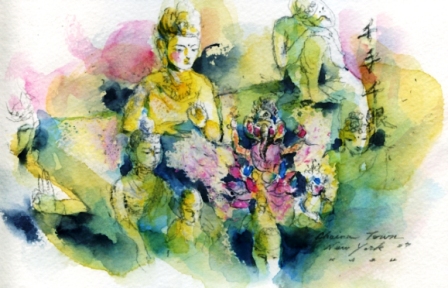
Actually, most Japanese don’t consider Shinto a religion. It’s a part of life for Japanese, and there are, in fact, no paths to become Shinto. If your parents are Japanese, you’re automatically Shinto when you’re born. You don’t have to go to Sunday school or have communion or even read a holy book, because there is none. Without any effort, you’re already in!
After I realized that Shinto was in fact a religion, I asked myself. “What are the teachings of Shinto?” This is a very hard question to answer though, because Shinto and Buddhism have coexisted since the 6th century, and they have influenced each other ever since. So, it’s very hard to differentiate between the two. However, since the ancient times, Japanese have only incorporated into their lives the parts that fit their sentiments and daily practices. So, I have conveniently decided that the distinction between Shinto and Buddhism may not be so important.
Unlike Christianity, Islam and Judaism that have clearly defined belief systems and teachings, Shinto provides very little. So then, how can a Japanese belief system appear as part of a person’s daily life? An easier question may be “What kinds of things don’t sit well in Japanese stomachs?”
One thing that bothers Japanese is exercising too much control over nature. In other words, Japanese try to live in harmony with nature. When it’s hot outside, the room temperature is set higher and when it’s cold outside, the room temperature is set lower, so that they can live with the same rhythm with nature. Since 2005, the Japanese Ministry of Environment has recommended setting the temperature indoors to 28°C (82°F) during the summer and 20°C (68°F) during the winter. While I must confess that 26°C (78°F) was the highest I could tolerate during the humid summer nights in Tokyo, these recommendations are not too far from Japanese common sense.
So, I was very surprised when I found Americans’ apartments so warm in the winter that I needed to take my sweater off, and so cool in the summer that I needed to put my sweater on. This seemed backward. Humans have an enormous ability to adapt and can live in the snowbound areas as well as on the equator. Americans, however, seem to discount this basic human ability.
Another aspect of life that bothers most Japanese is wasting food. Every Japanese I’ve met in the U.S. laments Americans’ attitudes towards food. Many Americans order as much as they want and end up wasting a lot of food. At parties, they put everything that looks enticing on their plates, and throw out what they can’t finish. When I see that, I feel a pain in my stomach. It’s a physiological reaction, and I couldn’t explain it in words. However, one day I heard myself saying to my kids, “We live on other lives: plant lives and animal lives. We need to eat those lives to survive, but we don’t want to waste any lives.” This is something Japanese learn early in life, and it is further instilled through elementary school years when they serve and eat the same school lunch together.
Shinto shrines are open 24 hours seven days a week, just as nature is, and they welcome everyone regardless of their religious affiliation. The only thing you need to learn is a simple way to pray. There are some minor variations, but usually you bow twice, clap twice, say your prayer in your head and then bow again. It is simple and therefore very inclusive. I really love this aspect of Shinto. It seems to me that Japanese in ancient times were very easygoing and open-minded. They sought harmony with nature and people resided in the sacred land of Japan.
One of my Japanese colleagues said “I want to encourage Japanese to apply the sense of harmony among Japanese with non-Japanese.” I wasn’t sure what he meant, and he kindly explained, “Japanese are harmonious among themselves, but they don’t apply the same harmonious attitude toward non-Japanese.” This is very true, although there are many Japanese who extend their harmony to everyone they interact with.
I love sushi. My late father-in-law used to say “Sushi is god’s food.” I also love being Shinto. I like its openness and inclusiveness and its easy practice. But where there’s a light, there can also be a shadow. Shinto was hijacked by the imperial government and military in the early part of the 20th century. Japan under the name of State Shinto inflicted enormous pain and suffering to people in neighboring countries.
Whether it is sushi or a religion or anything else, we can’t rely on one thing alone to make us all happy. We need to constantly check what we’re thinking and doing, and make a conscious effort to bring peace into our lives. Let me begin, then, by extending my harmony to those who use energy to keep themselves comfortable throughout the year and those who discard their leftover food.
Oh my eight million kami! This is so hard!